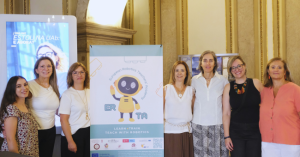
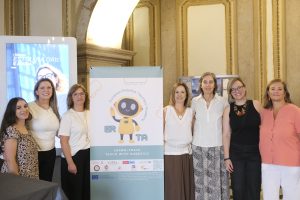
The Universidade Aberta hosted the second face-to-face meeting of the European project ERTA – European Robotics Teachers’ Academy.
Funded by the Erasmus+ programme, this initiative brings together universities, schools, public bodies, and specialised organisations from several European countries with the aim of promoting the integration of Educational Robotics into teacher education and training.
The meeting brought together around 30 researchers, lecturers, and trainers from partner institutions, providing a space for sharing experiences, reflection, and collaborative work on Educational Robotics, Computational Thinking, and pedagogical innovation, areas that are becoming increasingly relevant in preparing new generations for the challenges of the digital society.
Coordinated by the University of Tübingen (Germany), the ERTA project seeks to develop an innovative and interdisciplinary approach to the use of robotics in educational settings, encompassing not only STEM (Science, Technology, Engineering and Mathematics) skills but also creativity, emotional intelligence, inclusion, and problem-solving abilities from the earliest years of schooling. Portuguese participation is ensured by Universidade Aberta through LE@D – the Laboratory for Distance Education and eLearning.
During the two-day meeting, participants discussed the progress achieved by the various international teams and defined the next stages of the project, including the development of training programmes for teacher educators and in-service teachers, as well as the creation of innovative educational resources aimed at integrating robotics into pedagogical practices in an inclusive and accessible way.
The meeting was also marked by the official launch of the ERTA Community of Practice (CoP), a European learning and collaboration community designed for researchers, educators, trainers, and professionals interested in Educational Robotics and Computational Thinking. This platform will facilitate the sharing of resources, experiences, and best practices, strengthening cooperation networks among participants and promoting the continuous development of knowledge in this field.
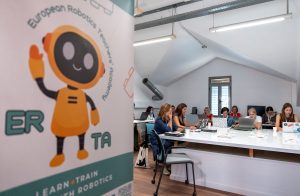
Another highlight of the event was a hands-on educational robotics workshop, which gave participants the opportunity to explore methodologies, tools, and pedagogical strategies focused on the use of robotics as a means of active, creative, and interdisciplinary learning.
With a planned duration until 2028 and a total budget of approximately €1.5 million, the ERTA project aims to contribute to the transformation of teacher education in Europe by developing models, resources, and recommendations that support the pedagogically sound use of robotics in educational contexts.
By hosting this second international meeting, Universidade Aberta reinforces its commitment to research, pedagogical innovation, and European cooperation, consolidating its role in projects that promote educational quality and prepare citizens for the challenges of the digital future.